

What Is Payment Reconciliation? Its Role in Payment Systems
Payment reconciliation is the process of comparing a business's own transaction records with bank statements and PSP reports to verify consistency. In...
Read More →The gap between when a sale is made and when the money actually lands in your account shapes cash flow planning directly. How do you keep visibility across multiple banks? We look at the role payment orchestration plays in solving this.
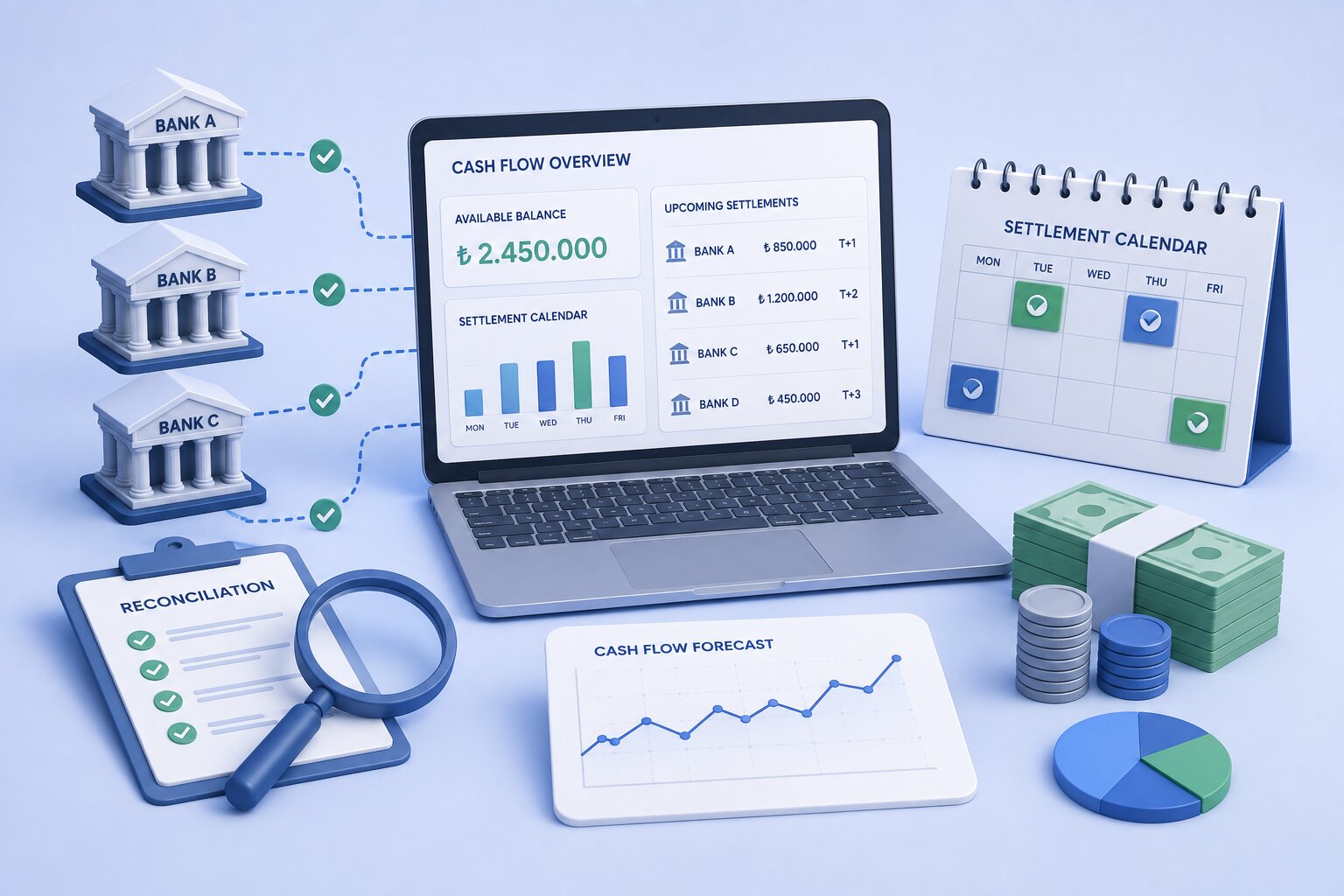
Making a sale is only half the story for a business; what really matters is when and how the money behind that sale actually reaches the account. A payment taken through a virtual POS is deducted from the cardholder's account instantly, but it typically only reaches the merchant's account after a defined settlement period. This delay has a serious impact on cash flow planning, especially for merchants operating at high volume or across multiple banks.
Acquiring banks apply different settlement periods depending on transaction type (single payment vs. installment), merchant risk profile, and internal policy. Some banks settle within T+1 day, while others settle each installment separately, on a monthly cycle. For a merchant working with several banks, this means tracking a separate cash flow calendar for each one.
Consider an e-commerce business integrated with five different banks: manually tracking statements and payment notifications that arrive in different formats and at different times from each bank makes it nearly impossible to see an accurate daily cash position. Finance teams end up budgeting without a clear answer to "how much cash do we have today, and how much will land tomorrow."
Reconciliation is the process of matching transaction records against bank movements, and accurate cash flow forecasting depends on a healthy reconciliation process. A merchant with delayed or error-prone reconciliation cannot reliably know its true cash position.
In a marketplace model, a portion of the collected amount goes to the platform and a portion to sub-merchants. Cash flow tracking must then happen separately for dozens of sub-merchants rather than a single entity — a scale that quickly becomes unmanageable manually.
Some payment providers offer early settlement options for merchants who don't want to wait out the standard settlement period. In exchange for a fee, this provides faster access to cash and can be a strategic tool during periods of tight cash flow.
Cash flow management is about knowing when a sale actually turns into usable cash, not just tracking sales figures. For merchants working with multiple banks, maintaining that visibility through manual processes becomes increasingly difficult. Treps's payment orchestration infrastructure consolidates settlement and reconciliation data from every bank into a single dashboard, simplifying cash flow planning.
Related reading: Payment Reconciliation and Multi-Bank Integration.
For virtual POS, payment orchestration and integration needs, let our expert team guide you to the best solution.
Payment reconciliation is the process of comparing a business's own transaction records with bank statements and PSP reports to verify consistency. In...
Read More →
Virtual POS commission is not a single fixed rate; it varies per transaction with card type, number of instalments, on-us/not-on-us status, settlement...
Read More →
The settlement value date (known in Turkey as valör) is the date on which the proceeds of a virtual POS sale reach the merchant's account and become u...
Read More →